AI-Generated CLMs: Why “Built in a Garage” Content Does Not Convince Pharma
Insights · CLM & AI
AI-Generated CLMs: Why “Built in a Garage” Content Does Not Convince Pharma
Pixels Health · November 4, 2026 · 6 min read
In short: AI can generate a CLM presentation in minutes, but fully AI-made eDetailing rarely meets pharma standards. It looks generic, puts scientific claims at risk and often breaks on the CRM. The model that works combines AI speed with CLM specialists and human validation.
Type a prompt, upload a brand guideline, and an interactive deck appears. It is impressive in a demo. In front of a brand team, a medical reviewer or an MLR committee, it is often a different story: the content looks like it was built in a garage, not by a partner trusted with a pharmaceutical brand.
The gap is clear: AI is everywhere in pharma marketing, yet confidence in AI-made content remains low. CLM, which sits at the heart of the rep–HCP conversation, is where that gap matters most.
Why 100% AI CLMs do not convince pharma teams
1. Generic design that ignores the brand
Pharma brands invest heavily in visual identity, claim hierarchy and positioning. AI tools produce layouts that look polished at first glance but feel interchangeable: the same templates and stock-style visuals from one product to the next. Reps notice, and so do HCPs.
2. Scientific claims without solid references
A CLM is promotional material. Every claim must be backed by an approved reference and stay consistent with the label. Generative AI can rephrase or “improve” a statement in ways that change its meaning, and regulators are watching closely.
In September 2025, the FDA’s promotion office sent nearly 100 enforcement letters in one week, after issuing about five per year in 2023 and 2024 [4]. Most targeted unsubstantiated or misleading claims. Unreviewed AI content increases exactly this type of risk.
3. Interactivity that breaks on the real platform
A deck that runs in a browser is not a CLM. It must be packaged for Veeva CRM, Vault CRM or IQVIA OCE, with correct structure, navigation and tracking. Many AI-generated decks fail at this step, and the time saved upstream is lost in rework.
4. No accountability
When a medical director asks who validated a slide, “the AI generated it” is not an answer. Pharma needs traceable decisions, named reviewers and version control.
Producing more content is not the goal. Producing content reps use is.
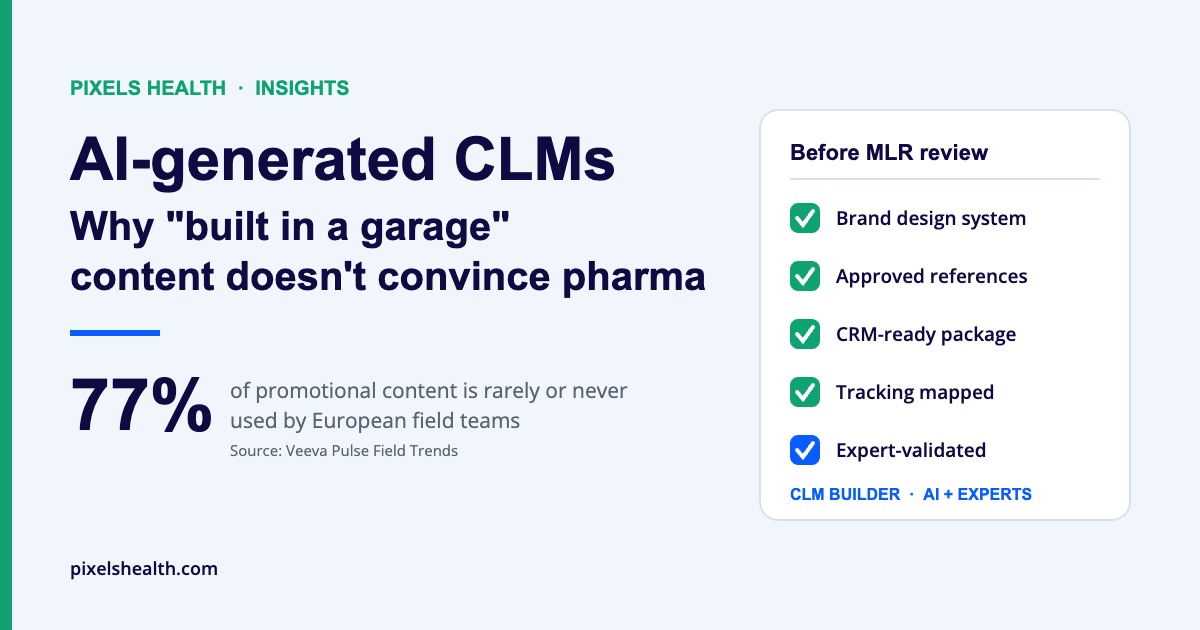
According to Veeva Pulse data, HCP engagements that include shared content lead to more than twice as many new patient starts [6]. Yet in Europe, reps share digital content in only 30% of meetings, and 77% of the content produced is rarely or never used [5]. Flooding reps with quickly generated decks does not solve this. Credible, brand-consistent content does.
What this means for brand teams
The value of AI in CLM is not volume. It is producing presentations that are faster to build, easier to localise and good enough that reps want to use them, without adding risk in MLR review.
AI is not the problem. The absence of expertise is.
Used well, AI genuinely helps: drafting first layouts, adapting content to new markets, creating scientific visuals, translating and checking consistency. What separates an amateur tool from a professional workflow is what surrounds the AI:
| Criterion | 100% AI tool | AI-assisted, expert-validated |
|---|---|---|
| Design | Generic templates | Brand design system locked in |
| Scientific claims | Rewritten silently | From approved references, changes flagged |
| CRM compatibility | Browser demo, rework needed | Packages built and tested for the target CRM |
| Tracking | Often missing | Key messages and events mapped |
| Accountability | None | Named CLM specialists before MLR |
Our approach: AI-assisted, expert-validated
At Pixels Health, a Geneva-based digital healthcare agency, we have produced CLM and eDetailing content for pharmaceutical companies for years as a Veeva content partner. We built CLM Builder to bring the speed of AI into that expertise, not to replace it.
- Brief and brand system: your guidelines, approved components and references are loaded first.
- AI-assisted build: CLM Builder generates and adapts slides inside that framework.
- Expert review: our CLM specialists check structure, interactivity and tracking.
- CRM-ready package: delivered for your platform and ready for your MLR process.
Key takeaways
- Fully AI-generated CLMs often look generic and raise compliance risks.
- Regulatory scrutiny of promotional claims increased sharply in 2025.
- The real challenge is content that reps use, not more content.
- The right model combines AI speed, brand control and human accountability.
FAQ
Can AI create a compliant CLM presentation on its own?
No. AI can draft layouts, adapt content and speed up production, but claims, references and fair balance must be validated by people. In pharma, MLR review and named accountability remain mandatory.
What makes an AI-generated CLM look unprofessional?
Generic templates that ignore the brand guidelines, scientific wording rewritten without references, and packages that break navigation or tracking once loaded into Veeva CRM, Vault CRM or IQVIA OCE.
Is AI still useful for CLM and eDetailing production?
Yes. Used inside a brand design system and followed by expert review, AI shortens production time, simplifies localisation and helps teams create more content that reps actually use.
How does CLM Builder differ from generic AI tools?
CLM Builder works within the brand’s approved components and outputs CRM-ready packages. Pixels Health’s CLM specialists review every presentation before it enters the client’s MLR process.
Which CRM platforms does Pixels Health support?
Pixels Health produces CLM and eDetailing content for Veeva CRM and Vault CRM and converts content for IQVIA OCE, with other platforms such as Salesforce in progress.
Want to speed up CLM production without losing quality? Discover our Veeva and CLM services or talk to our Geneva team.
Sources
- eMarketer, Generative AI for Pharma Marketing, citing a September 2024 survey by Medical Marketing & Media and Publicis Health.
- eMarketer, Pharma marketers and ad agencies use genAI, citing a ZS survey of 60 executives.
- Business Wire, Survey: 65 Percent of Pharma Marketers Distrust AI for Creating Regulatory Compliance Submissions, Klick Health & Momentum Events, November 2025.
- Hall Render, analysis of FDA OPDP enforcement in 2025.
- Veeva, Expand HCP access with connected engagement: Veeva Pulse data, Europe.
- Veeva, Veeva Pulse Report finds content-driven engagement lags despite proven boost to treatment adoption, May 2025.