How Bridge AI Simplifies the Transition from Veeva to IQVIA for Pharmaceutical Companies
How Bridge AI Simplifies the Transition from Veeva to IQVIA for Pharmaceutical Companies
For a sales director or a Sales Force Effectiveness (SFE) manager in the pharmaceutical industry, the challenge is never framed in terms of HTML or CSS. It comes down to field visits,sales rep adoption rates, the consistency of the message delivered to healthcare professionals (HCPs) across every channel face-to-face, email, portal, webinar and the ability to orchestrate a seamless omnichannel strategy that flows smoothly from one system to the next. CLM (Closed Loop Marketing) content is, in this context, merely a vehicle what really matters is that the right message reaches the right HCP at the right time, with full traceability for regulatory compliance.
This is where the choice or switch to a CRM platform such as Veeva, IQVIA OCE ,Salesforce Life Sciences Cloud, or Cegedim, ceases to be an IT issue and becomes a matter of sales performance. A poorly managed migration isn’t just a file compatibility issue it poses a direct risk to adoption on the ground, to the continuity of SFE dashboards, to the monitoring of HCP engagement metrics, and to the teams’ ability to maintain their pace of work during the transition. A sales rep who loses access to their CLM content on the go-live day of a new platform isn’t just a technical glitch, it’s a missed visit,a lost sales opportunity, and a metric that drops for the quarter.
Behind the scenes, this sales performance issue translates into a very concrete project manually rebuilding presentations, adapting HTML files, resolving technical incompatibilities, and coordinating numerous back-and-forth exchanges between agencies and business teams. CLM migration remains one of the most costly operational projects in pharmaceutical marketing,but its true cost is measured first and foremost in sales force performance not just in development hours. Bridge AI was developed by Pixels Trade (pixelstrade.com) to address this dual challenge, both commercial and technical, with the pharmaceutical digital expertise of Pixels Health (pixelshealth.com).
Overview: Beyond Veeva and IQVIA
Veeva and IQVIA dominate the conversation, but they are no longer the only two major players in the market. Since the breakdown of the long-standing partnership between Veeva and Salesforce in late 2022, the landscape has shifted to include at least four families of platforms.
Veeva has migrated its CRM to its own Vault architecture, which has already seen significant adoption more than 115 Vault CRM deployments in production and nine of the world’s top twenty biopharmaceutical companies committed to the platform, according to figures released by Veeva in the third quarter of its 2026 fiscal year.
Salesforce responded with Life Sciences Cloud co-developed with IQVIA’s OCE technology more than 70 life sciences customers were announced in early 2026, including Pfizer ,Takeda, Boehringer Ingelheim, and Fresenius Kabi.
Cegedim CRM (Cegedim Relationship Management) remains a long-standing player that is often underestimated outside of French-speaking Europe. With a presence in France, Switzerland, the United Kingdom, and French-speaking Africa, the group built its business on life sciences CRM starting in the 1990s and today maintains a leading position in the pharmacy and medical practice segments in Europe.
Oracle and SAP round out the landscape in the areas of data, real-world evidence, and supply chain, with a more peripheral CRM integration.
For a French-speaking European and African player, this landscape analysis is important content conversion isn’t limited to the Anglo-Saxon Veeva–IQVIA axis. It’s just as relevant for pharmaceutical companies migrating to or from the Cegedim ecosystem, which has a particularly strong presence in the markets that Pixels Health serves on a daily basis.
Why is migrating between platforms still so complicated?
These platforms perform similar functions,but their technical architectures differ significantly. A presentation designed for one cannot be directly used in the other. Behind every seemingly simple CLM content lies:
- A technical structure unique to each platform
- Metadata specific to the target ecosystem
- Distinct navigation mechanisms
- HTML components that are not interchangeable
- Different tracking and measurement logic.
As a result,many projects force teams to essentially start from scratch every time they switch environments.
A direct impact on marketing and digital teams
In practical terms,this incompatibility results in several weeks of production,high technical costs,delays in campaign launches,and additional regulatory approval cycles (MLR). On the ground,it also results in a temporary desynchronization of omnichannel orchestration “next best action” recommendations lose their relevance until the content is reclassified on the new platform sales representatives’ adoption time slows down their visit frequency and there is a gap in SFE management while dashboards resynchronize. For pharmaceutical groups operating in multiple markets,the problem becomes structural every market and every platform change triggers the same costs both commercial and technical.
Interoperability and Vendor Strategy: What Isn't Usually Said
We must address here what is rarely addressed,without claiming a level of objectivity that no one fully possesses in this debate including Pixels Health since Bridge AI is itself a commercial solution. The difficulty of switching from one ecosystem to another is not merely a technical issue proprietary formats and the lack of interoperability standards between platforms effectively function as exit barriers.
This is not unique to the pharmaceutical industry or healthcare software it is a recurring pattern in the history of enterprise software,documented well beyond this sector,as the parallel below illustrates. Pointing this out is not an accusation against Veeva,IQVIA,Cegedim,or Salesforce it is a rational business decision that these vendors share with virtually the entire enterprise software industry.
This unspoken reality was tenable as long as content conversion required rare expertise and considerable manual labor. It is becoming less and less so as artificial intelligence enables the automated analysis and reconstruction of proprietary structures. What used to be a project taking several weeks is now a simple process. Content portability thus ceases to be a matter for experts and becomes a criterion for selecting the platforms themselves.
A More Relevant Comparison: Marketing Automation Platforms
When people try to argue that a closed ecosystem guarantees stability,Apple is the first example that comes to mind a single vendor that controls the chip,the operating system,and the apps delivers a quality of experience that a multi-vendor ecosystem sometimes struggles to match. The argument is valid,but it rests on a specific level of technical complexity Apple’s vertical integration manages real-time coordination between hardware and software an engineering challenge where openness comes at a measurable cost.
CLM content does not reach that level of complexity. Its underlying layer HTML,CSS,images,and video has been a mature standard for over twenty-five years and is natively interoperable. Therefore,it is not the stability of the content that would justify a closed architecture it is something else.
The right parallel isn’t found in hardware proprietary printer cartridges,for example,are subject to a commercial lock-in on a physical consumable,which has nothing to do with the stability of digital content. It’s found in a software layer very similar to that of CLMs the proprietary customization languages of marketing automation platforms.
In Salesforce Marketing Cloud, email content remains standard HTML,readable by any email client in the world. But Salesforce overlays it with AMPscript, a proprietary scripting language executed on its own servers to drive personalization and access to customer data. HubSpot does the same with HubL,a language built on Jinja an open-source templating engine that has been transformed into a proprietary,non-portable dialect. A recent independent audit of the platform explicitly notes that HubL templates remain proprietary and that extracting them requires significant effort. Adobe Marketo,for its part,combines personalization tokens and Velocity script blocks to achieve the same functionality.
Three different publishers,three different languages,a single common logic the core content is open and interoperable,but the customization and conditional logic layer the one that makes the content truly usable in production is proprietary and non-transferable. Migrating from AMPscript to HubL isn’t just a matter of converting HTML it involves manually rewriting every condition,every data call,and every dynamic block in an entirely different syntax to essentially do the exact same thing.
This is precisely the mechanism found in pharmaceutical CLM,which operates at a higher level of regulatory complexity. What makes a Veeva presentation incompatible with IQVIA is not the content,but the navigation,metadata,and tracking layer specific to each platform built on the same logic as AMPscript or HubL a proprietary syntax for controlling content that is otherwise universal.
This layer serves a real purpose in terms of engagement tracking,multichannel orchestration,and compliance functions that would not exist natively in pure HTML. But there was no reason it had to be non-portable technically,nothing prevents a vendor from documenting an open schema for this layer rather than a closed format. The decision to use a closed format was an economic choice,not an engineering necessity. A sign that the direction can change Salesforce is currently migrating some of its users from AMPscript to HML,a new layer built on the open-source Handlebars.js engine proof that the closed format was not a technical inevitability.
Bridge AI: A Smart Approach to CLM Conversion
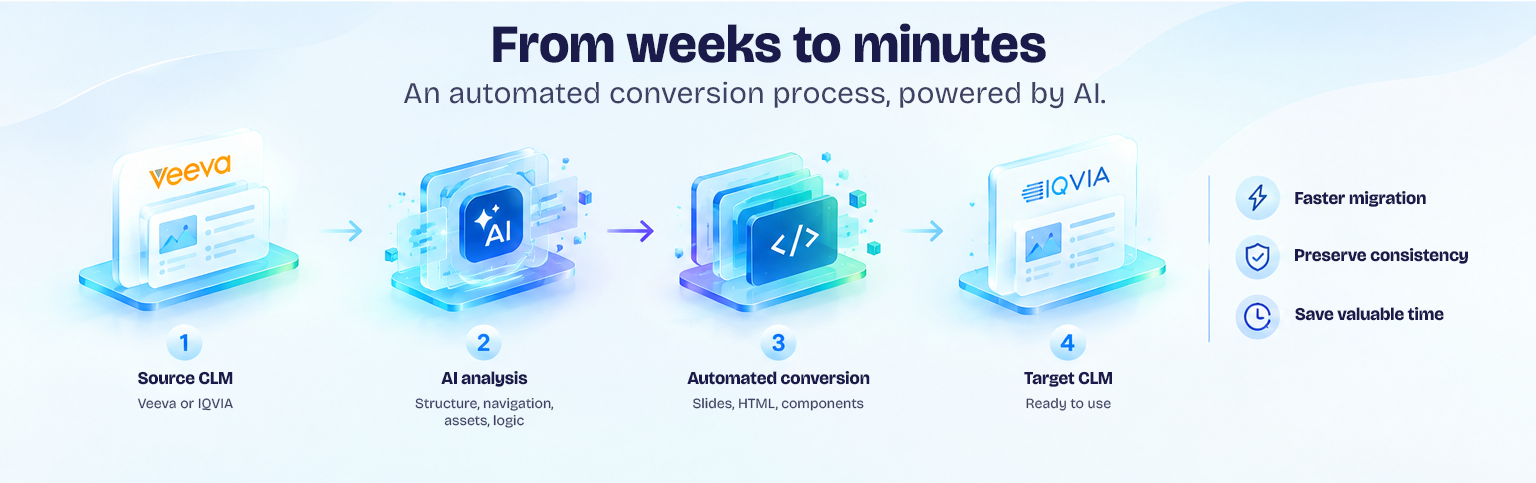
Bridge AI was designed with a simple goal in mind to save teams from having to rebuild their content manually. The platform automatically converts CLM files between Veeva and IQVIAin both directions as well as to and from other formats such as HTML,PPTX,and PDF. The user uploads an existing package,Bridge AI analyzes its structure,and then generates a version compatible with the target platform.
Converting from Veeva to IQVIA
When a pharmaceutical company migrates to IQVIA,Bridge AI retrieves existing slides,adapts HTML components,rebuilds navigation links,converts assets,and produces a structure that can be deployed quickly. The challenge is not to simply “copy” content,but to preserve all of its functional logic.
Converting from IQVIA to Veeva
The same process works in reverse. This bidirectional capability is particularly useful for international pharmaceutical groups,subsidiaries using different platforms,global campaigns,phased migrations,and multi-agency projects.
A solution designed for the realities of the pharma industry
At Pixels Health,digital projects in the pharmaceutical industry consistently reveal the same imbalance teams devote a considerable amount of time to technical tasks that have no real marketing value. Bridge AI was built around the industry’s specific challenges regulatory compliance,complex validation cycles,multi-country management,content maintenance,and the need for rapid deployment.
Reducing Campaign Time-to-Market
In an environment where teams must deliver faster and faster,speed of conversion becomes a competitive advantage. Projects that used to take weeks can now be completed in a significantly shorter time,enabling faster international rollouts,shorter migration timelines,and simplified collaboration between agencies and pharmaceutical teams.
The Specific Benefits of Bridge AI
Operational time savings Teams no longer have to rebuild their presentations from scratch. Reduced technical costs Less custom development means less budget spent on repetitive tasks. Streamlined workflows Content becomes easier to align across markets and platforms. Bidirectional compatibility Bridge AI works from Veeva to IQVIA and from IQVIA to Veeva,while supporting additional formats such as PDF,HTML,and PowerPoint.
What Automated Conversion Does Not Replace
Bridge AI drastically reduces the technical complexity of migration it does not replace the judgment of compliance teams,approval processes,or human quality control for the most specific components. It is this clear definition of scope that distinguishes serious automation from a marketing promise.
Bridge AI,a project developed by experts in the digital pharmaceutical sector
Bridge AI is developed by the teams at Pixels Trade (pixelstrade.com),drawing on the digital pharmaceutical expertise of Pixels Health (pixelshealth.com). The goal is clear to help pharmaceutical companies and agencies streamline and accelerate their CLM operations by reducing the technical complexity of migrations between platforms.
As digital pharmaceutical ecosystems become more hybrid and international,this type of automation is set to become an industry standard and,with it,a new requirement for transparency regarding content portability. Discover the solution on Pixels Trade (pixelstrade.com) or explore the digital pharmaceutical expertise of Pixels Health (pixelshealth.com).
Editorial Transparency Note: Bridge AI is developed and marketed by Pixels Trade this article is published by Pixels Health,which is part of the same group. This affiliation is disclosed in accordance with transparency standards in scientific and technical publishing (ICMJE and COPE principles on the disclosure of conflicts of interest) and does not affect the accuracy of the market data cited,which is sourced independently.
Frequently asked questions
How can I convert CLM content between Veeva and IQVIA?
Bridge AI analyzes the existing package and automatically generates a version compatible with the target platform, in both directions.
Why is migration between pharma CRM platforms so complex?
Each platform uses its own technical structure and metadata, which are not interchangeable, even though the underlying HTML content remains standard.
Does Bridge AI replace compliance teams?
No. It reduces technical complexity, but it does not replace MLR review or human quality control.